Almada's water cuts.
For 31 days, from 2 July to 2 August 2026, over 100,000 people in Almada, across Costa da Caparica, Charneca, Sobreda, Capuchos, Laranjeiro and Feijó, lived with rotating water cuts, some lasting 12+ hours. It wasn't water quality (SMAS holds ERSAR's 2025 "Exemplary Water Quality" seal): it was capacity. Consumption was the highest in 75 years, and demand concentrated exactly where the network is weakest. A petition gathered nearly 4,000 signatures, 1,500 people marched, and a motion of censure was tabled and rejected. The cuts have stopped, but the municipal alert runs to 31 August and SMAS call the current calm "only a test phase". Here is what the open data shows.
1 · The crisis, in human terms
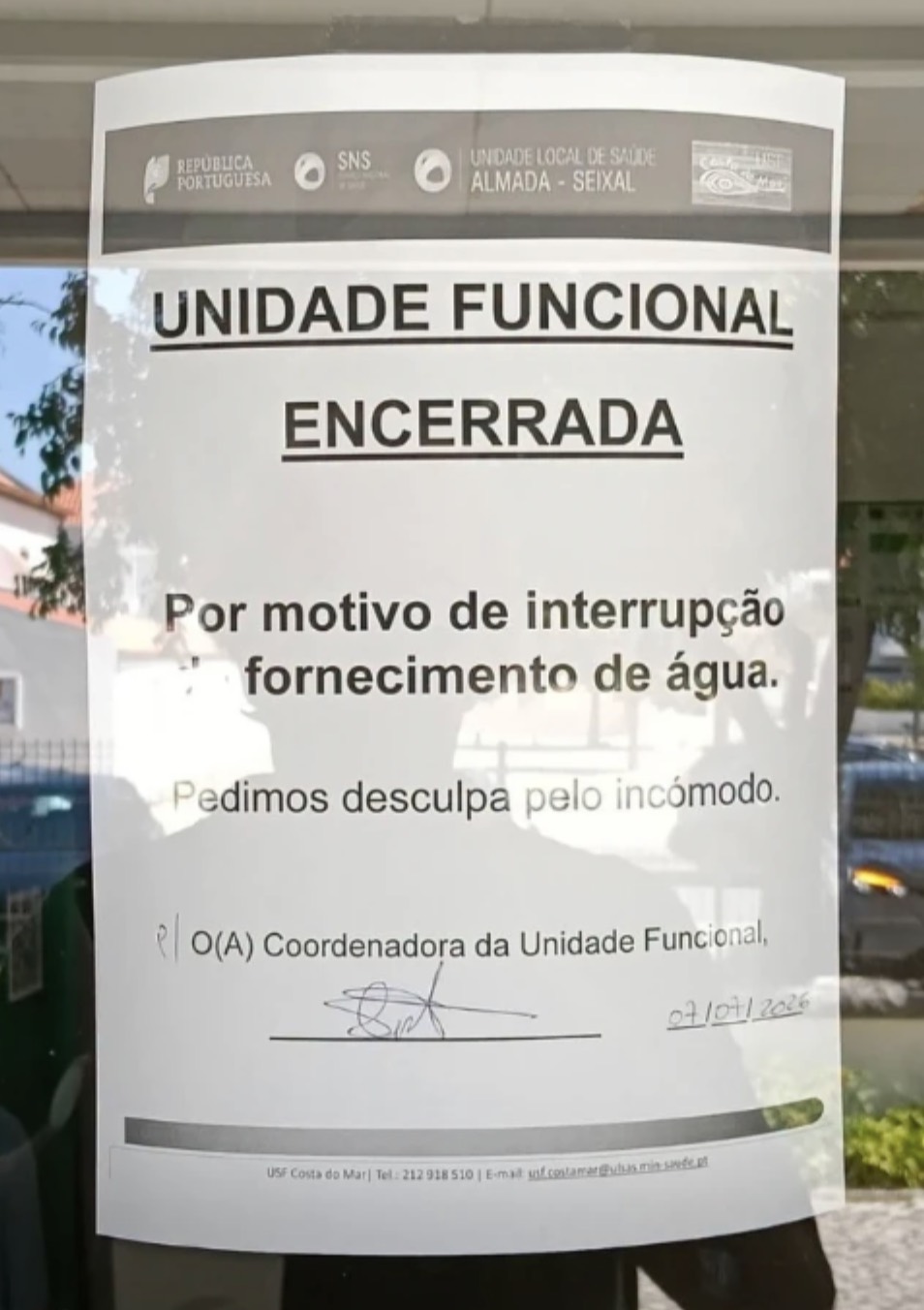
12+ consecutive hours without water in Costa da Caparica (Diário de Notícias); by 6 July, some residents report six days without reliable water (Observador). a case reported to DECO PROteste: a Costa da Caparica household went without water from 4pm to 11pm, 7 straight hours, with no warning. A network fault in Charneca da Caparica (N377) was reported to SMAS almost daily since 26 June, 9+ straight days by 5 July, a full week before the heat peak. Cafés and restaurants in Costa da Caparica, at the height of the beach season, forced to close or refuse service midday because they couldn't guarantee water for hygiene and food prep (Diário de Notícias · O Almadense). By 7 July, the Costa do Mar family health unit closed at 1pm over a water-supply interruption, per an official notice posted at its door; afternoon appointments and nursing treatments were rescheduled (RTP), and Cacilhas' volunteer firefighters made water available from a forestry tanker vehicle holding about nine thousand litres, throughout Tuesday 7 July, at the parish council's request, for basic household needs, not drinking. The council also bought a 1,000-litre stainless-steel container to distribute to the most vulnerable residents (Diário de Notícias). This is what "cortes de água" means before any chart of temperatures or tariffs:
last checked: 6 August. The rotating cuts ended on 2 August, after 31 days, but as a test: SMAS announced that “no overnight supply cuts are foreseen” and stressed, in the same note, that “this is only a test phase”, with measures able to be reactivated “immediately”. The alert status remains in force until 31 August and irrigation is still phased. Average reserves stood at 78% on 30 July, and from 6 August SMAS began publishing a public dashboard of that level. Structural stability is still pointed at the first quarter of 2027. The PSD's motion of censure was rejected on 22 July; the Ombudsman's analysis has no public conclusions
2 · The heat spike
Almada's estimated daily max temperature climbed to 38.7 °C on 02/07/2026, above the national mean of 37.3 °C that day. Heat spikes water demand (watering, showers, pools) exactly as the beach-season population arrives. It is one factor among several, not the whole story.
3 · The summer surge
This is no longer just a 2021 statistic. SMAS recorded the highest water consumption in 75 years in the Almada municipality, up 4.3% in H1 2026 versus 2025 (the historical average is ~2%/year), per Jornal de Notícias. By 8 July, the câmara cites daily consumption above 300 litres per resident in Almada, almost double the national average (around 180 litres per resident/day) (RTP · ECO). The growth concentrates exactly where the cuts hurt most: Charneca da Caparica +15.0%, Sobreda and Lazarim +15.0%, Costa da Caparica +14.0%. Pragal, Almada, Cacilhas and Cova da Piedade held flat or fell. The structural reason: Almada as a whole is average, at 17.0% second homes, below the national 18.5%, but the load concentrates on the coast, where 6,408 of 13,765 Costa da Caparica dwellings (46.6%) are second homes. In summer they fill and demand decouples from the resident population.
4 · The aquifer Almada drinks from
Almada's supply is 100% groundwater from the T3 · Bacia do Tejo-Sado / Margem Esquerda aquifer, which is why the fix is new wells, not a new river. The official groundwater-quantity network has 122 stations on this aquifer; only 52 are active, and 12 sit in the Almada area (4 active).
Groundwater-monitoring stations · aquifer T3 (SNIRH / APA)…
Each dot is a monitoring station on the Tejo-Sado left-bank aquifer. Hover for its code and status.
5 · How it got here
Two different failures, one year apart. In August 2025 the pipes burst: two large trunk-main ruptures cut Costa da Caparica. In 2026 the system ran out of capacity, in SMAS's own words: demand above what its wells capture daily. On 5 July, the 2025 failure mode returned on top of the rationing. The warnings predate the heatwave by weeks. The rationing itself ran 31 days and was wound down in three official steps, between 26 July and 2 August.
6 · The politics: who answers
Inês de Medeiros (PS) has led the câmara since 2017, re-elected in October 2025 to a 3rd and final term with 29.1%. The PS-CDU governance agreement (17 Nov 2025) handed the SMAS presidency to the CDU; an external audit of the municipal universe was also agreed. Since December 2025, SMAS is chaired by Luís Palma (CDU), and the mayor herself sits as first board member. Palma chaired the Laranjeiro e Feijó parish union from 2013 to 2025, two of the parishes now facing cuts. In August 2025 the CDU blamed “the executive's systematic refusal to invest” in the water networks. Since December 2025, a CDU councillor chairs SMAS. On 6 July, Paulo Sabino (PSD), councillor and president of PSD Almada, announced he would escalate to a formal motion of censure against the PS-CDU executive, an accusation, not a fact Questiona adopts. On 22 July, the motion of censure announced by the PSD was debated in the municipal assembly and rejected in the early hours, after more than five hours of debate: PS, CDU and Livre against, BE abstaining, PSD, IL and Chega in favour. The motion was not binding, so it could never have affected the executive's continuity.
Central government: Maria da Graça Carvalho, Environment and Energy Minister said she was in “permanent” contact with water services; framed Almada as a local abstraction/distribution problem, not drought: “temos reservas de água, porque choveu muito este inverno”. The regulator ERSAR asked SMAS for explanations (made public 4 July). By 7 July her tone had hardened, naming Almada as the country's worst offender: “Almada é talvez o município com maiores perdas de água, tem muito acima da média, mais de 35%”. She said the câmara had raised no alarm beforehand: “Não tínhamos nenhum alerta da Câmara de Almada sobre problemas, nem nenhum pedido”. The APA's president was visiting Almada that same afternoon to speak with the municipal executive and see what help is needed. The mayor pushed back on 8 July, blaming unexpected network diversions (“Fomos surpreendidos com desvios de rede onde não estávamos a contar”) and, responding to the minister, said the câmara had already proposed a €10.7M investment under the PRR to reinforce the network, and put a hard number on it (“Os reservatórios estão com 10% quando deviam estar a 60%”); on 9 July, admitting a “difficult reality”, she set a target of halving consumption in the coming days so the reservoirs can recover. On 10 July a second oversight body entered: the national Ombudsman (Provedoria de Justiça) opened an analysis of the supply failures after residents complained (complaint-based, not own-initiative).
7 · The response and the money
The official fix is wells: both 2026 boreholes are now running, 3 more are in licensing and 3 in design. GW1 came online on 12 July; the second well came online by 19 July: on that date the câmara had “two new boreholes” injecting an extra 120 m³/hour into the network, double the first well's own 60 m³/hour. The second's exact start date was not disclosed (Renascença · JN · 19 jul 2026). In the municipal plan, the two 2026 wells appear in the plan as Aroeira (Almada) and Corroios (Seixal); on Antena 1, the mayor and SMAS spoke of two more wells by the end of 2026. The câmara activated a contingency plan and set up a crisis cabinet, announced by vice-president Filipe Pacheco at the 6 July public executive meeting, after the mayor had already publicly apologised for the disruption (Renascença). On 8 July, the câmara and SMAS jointly decreed an alert status in the municipality, with a long list of banned uses: garden and lawn irrigation (public and private), golf-course watering, vehicle washing, pool filling, beach showers and foot-washes, ornamental fountains and artificial lakes, and washing exterior pavements, walls and roofs (except building-conservation work) (RTP · ECO); the decree guarantees priority supply to hospitals, health centres, nursing homes, fire brigades and other critical infrastructure, with tanker trucks in the most sensitive areas and stepped-up coordination with neighbouring municipalities. Meanwhile, rationing:
- “gestão solidária e rotativa da rede” (the official phrase: solidary, rotating network management)
- concelho-wide pressure reduction from 00:00 to 06:00 so reservoirs can recover
- total supply cuts in specific zones, from 22:00 to 06:00, with advance notice to residents
- stepped-up inspections where abnormal consumption is recorded, mainly in Charneca da Caparica, Sobreda and Costa da Caparica
- tanker trucks in zones where that proves necessary
- 24h emergency line: 800 205 712
The rotating-cut regime ended on 2 August, 31 days after it began, in three official steps. On 26 July, with reserves recovering, scheduled cuts stopped at weekends and, on other days, shrank from 22:00-6:00 to “generally” 1am-6am. On 31 July, the câmara extended the alert to 31 August but partially revoked the overnight-cut rule, which could now “be reduced or suspended in zones where operational indicators show safe conditions”, with at least 48 hours' notice. On 2 August, SMAS announced that, over the following week, “no overnight supply cuts are foreseen”. None of this is a declaration that the crisis is over: SMAS's own words are that “this is only a test phase” and that measures may need reactivating “immediately” if reserves fall. The alert runs to 31 August, irrigation is still phased, and structural stability is only expected in the first quarter of 2027.
Reserves averaged 78% on 30 Jul 2026 (SMAS de Almada · CM Almada).
The money: SMAS's 2026 budget is €39.8M, of which €8.0M is investment (investment covers water and sanitation; no water-only breakdown was published), approved by the câmara on 26 Jan and the municipal assembly on 11 Feb 2026. Tariffs were frozen in 2024, then +2.1% (2025) and +1.8% (2026) (changes computed from SMAS's official tariff schedules (Edital 1/2026)). On 9 July, visiting Almada, the Environment Minister said a new borehole would come online by the weekend, raising system capacity by about 20%, with two more being licensed, one of them “very large”, which she said would practically supply the water needed. The borehole (GW1) did come online on 12 July, running on a generator and ahead of the planned end-of-July date; SMAS put the reinforcement at an extra 60 m³/hour and said it ran the tests needed to guarantee water quality before connecting it to the network. (Lusa · Observador · ECO · JN). Longer term, Luís Palma (SMAS) said on 6 July that the crisis should stabilise within July as the second well comes online; mayor Inês de Medeiros spoke, on the evening of 7 July, of “two to three weeks” to recover some slack. The Strategic Water Supply Plan foresees a significant improvement in the first quarter of 2027, and the response, per the sector itself, will be “more effective” next year. No EPAL/Águas do Tejo Atlântico bulk connection or desalination has been announced.
8 · The public reaction
A petition, “Fim dos cortes frequentes de água em Almada – Exigimos uma solução urgente”, has 3,971 signatures (from 1,500 to 3,971 in two days), and the regulator ERSAR has asked SMAS for explanations. On 8 July it spilled onto the street: around 1,500 people gathered in Costa da Caparica and the silent human chain turned into a march between the Centro Comercial O Pescador and the IC21 access roundabout, blocking traffic, with calls for the mayor's resignation (Observador · euronews · SAPO), chanting “Inês para a rua, Almada não é tua”. On complaint platforms, SMAS Almada sits at the bottom of the water table. And on 9 July the consumer group DECO demanded redress for affected customers: a fixed-tariff waiver on bills for the cut periods, extended payment deadlines without interest, no supply cuts for non-payment on contested bills, and the compensations set out in the Service Quality Regulation (DECO · Observador · SOL). Important: this measures reaction and customer service, not water quality, which passes.
9 · The causes, in layers
Heat + the seasonal peak. In the operator's own words: “high temperatures and the significant rise in seasonal population”; “overall demand has exceeded the water we can capture daily from our wells”.
A 100% groundwater system, with many wells in the neighbouring municipality (Vale de Milhaços, Miratejo and Corroios, in Seixal; 2019 figures: 50-60,000 m³/day on average, 110,000 peaks, ~28% network losses). And short storage: the 00:00-06:00 pressure cuts exist precisely so reservoirs can recover.
There is also a dependency that crosses the municipal boundary: according to the Seixal municipality, 28 of the 32 boreholes that supply Almada sit in Seixal's territory, mostly in Corroios. The two municipalities are in dispute. Seixal's mayor, Paulo Silva, argues that “Almada has to pay for the water it captures in Seixal” and notes that in 2025 Almada was ordered by the Administrative Court to pay Seixal (a ruling now under appeal). Almada's mayor, Inês de Medeiros, replies that “the obstacles Seixal created caused a big problem here”, citing a borehole that collapsed and that Seixal reportedly blocked in court from being relocated, though she stresses she does not believe “it was intentional”. On 10 July, Seixal ceded a borehole to help, which the APA estimates will produce 1,800 to 2,000 m³/day, about 20% of the shortfall. Two versions, one shared fact: almost all of Almada's water is captured in a neighbouring municipality.
It is not drought: at end-May 2026, 0% of the mainland was in drought (IPMA) and national reservoirs sat at 86% (“We are very well prepared”, APA). National abundance never reaches Almada's taps because Almada does not drink from dams.
The warnings are on record: 2025's ruptures, the parish council's 9 June statement (“identified for many years”), the petition created on 21 June, before the heatwave. Tariffs were frozen in 2024 and have risen ~2%/year since; 2026 investment is €7.96M for water and sanitation. Nationally, ERSAR reports mains renewal at 0.5%/year against a 1.5% target.
Follow the money
SMAS Almada and the câmara are public buyers, and their contracts are public records. See who they pay:
The figures
- 31 daysthe rotating-cut regime lasted, 2 July to 2 August 2026SMAS de Almada · 2 Aug 2026
- 100k+people affected at the peakRTP · 3 Jul 2026
- +4.3%water-consumption growth, H1 2026Jornal de Notícias · highest in 75 years
- 9+ daysthe longest single fault ran unresolvedO Almadense · reported since 26 Jun
- 12+ hrslongest single continuous outageDiário de Notícias · Costa da Caparica
- 46.6%of Costa da Caparica homes are second homesINE · 2021 Census (18.5% nationally)
- 28 of 32boreholes that supply Almada sit in Seixal, the neighbouring municipality it is in dispute withMunicípio do Seixal · O Setubalense · 9 Jul 2026
- 3,971signatures on the water-cuts petition (nearly 4,000 by 6 Jul)Petição Pública · 2026-07-08
- 2+3+3new wells: running / licensing / designSMAS · CM Almada · 19 Jul 2026
- 22 Julthe PSD's censure motion is rejected (PS, CDU and Livre against; BE abstaining)O Setubalense · Observador · 2026
- 31 Aughow long the municipal alert still runs, with the cuts already stoppedCM Almada · 31 Jul 2026
- 38.7 °CAlmada's peak temperature (context, not cause alone)IPMA · 02/07/2026 (national mean 37.3 °C)
Every figure here comes from official open data.